
Mission readiness is a data problem.
Fleet maintenance systems were designed for a different era. Siloed data, reactive maintenance cycles, and legacy platforms that don’t communicate across organizational boundaries. The result: readiness gaps that compound when you can’t predict failure before it happens.
Siloed Systems
Maintenance logs, sensor telemetry, spare parts, and engineering data sit in separate systems with no shared context.
Reactive Maintenance
Without predictive capability, maintenance is driven by calendar or failure — both cost more than they should.
Security Constraints
Most commercial analytics platforms aren't built for air-gapped networks, ATO compliance, and strict data sovereignty.
The intelligence layer behind fleet readiness.
Peaxy Lifecycle Intelligence™ is engineered for the most demanding critical-asset environments. Over a decade of production deployment across defense, energy, and infrastructure.
Threaded Data Architecture
Continuous data threads across design, operations, testing, and maintenance — every system and component traced to the individual serial number.
Physics-Informed Digital Twins
High-fidelity emulators grounded in real asset behavior, validated against operational data from component to fleet.
AI / ML CBM+
ML-driven fault prediction, automated work orders, and Pareto-ranked remedies with spares status and test time estimates.
Defense-Grade Security
CMMC Level II compliant, NIST 800-171 and NIST 800-53 aligned. ATO with air-gap parity across gov cloud, on-prem, and shipboard deployments. Our team includes personnel with active DoD and DoE security clearances.
AI-driven maintenance programs aboard aircraft carriers and submarines.
Condition-based maintenance for the Navy's most critical systems, improving Ao (operational availability) from aircraft carrier operations to submarine propulsion and weapons handling.
Peaxy Lifecycle Intelligence™ threads real-time sensor telemetry, maintenance logs, error codes, and spare parts inventories across critical systems per carrier. Physics-informed emulators model each system’s behavior, while ML algorithms predict failures before they occur. The system operates across a distributed architecture — from hardened on-ship edge devices to shore-based installations and a GovCloud instance.
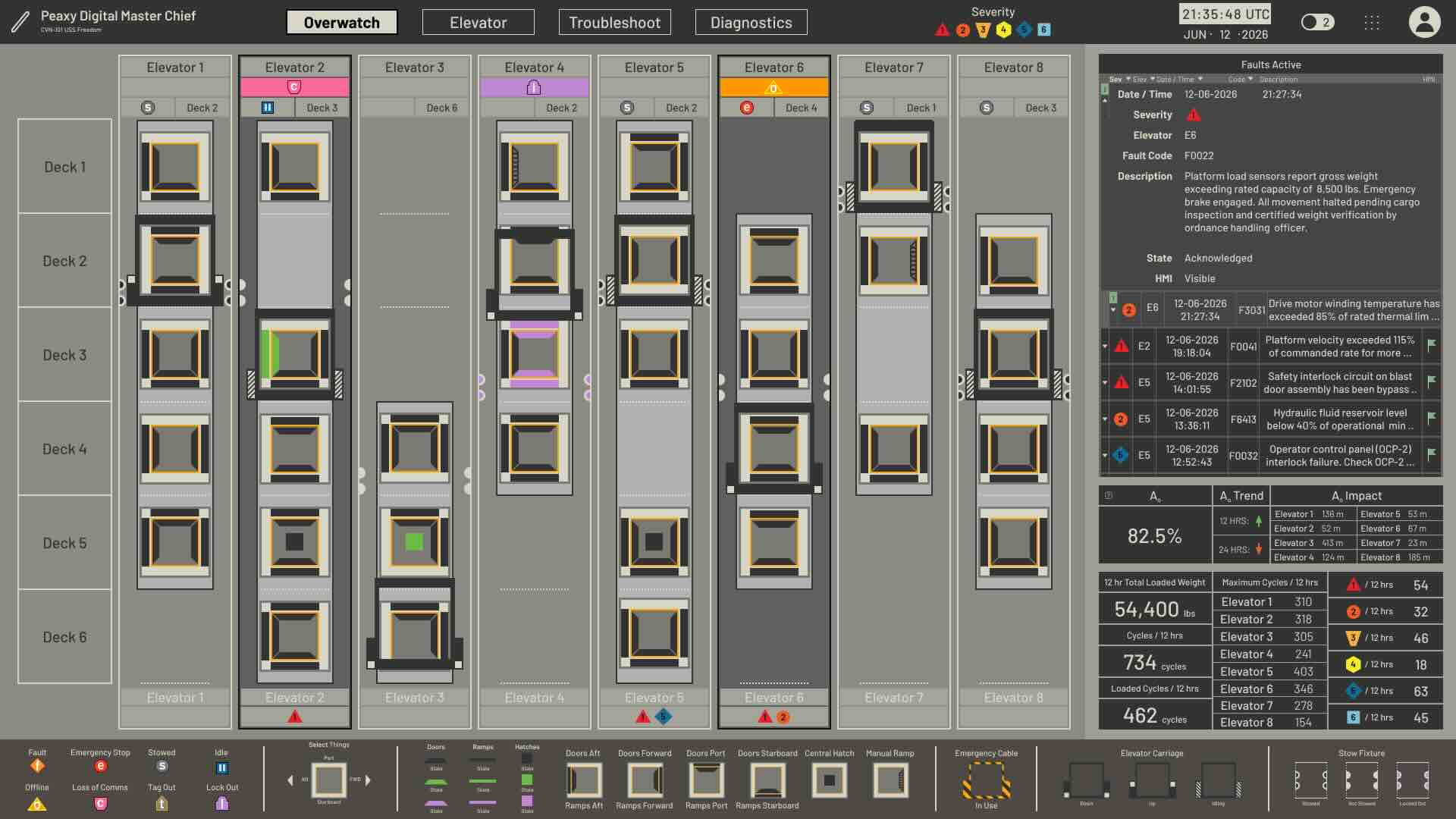
Peaxy Lifecycle Intelligence™ provides monitoring, data handling, emulation/digital twins, and machine learning for critical submarine systems, including on-board battery systems, weapons and ballasting compressors (HPACs), air scrubbing and handling equipment (ACRUs), diesel propulsion, and generators. The program ensures operational readiness and long-term sustainability for the Navy’s attack and ballistic missile class submarines.
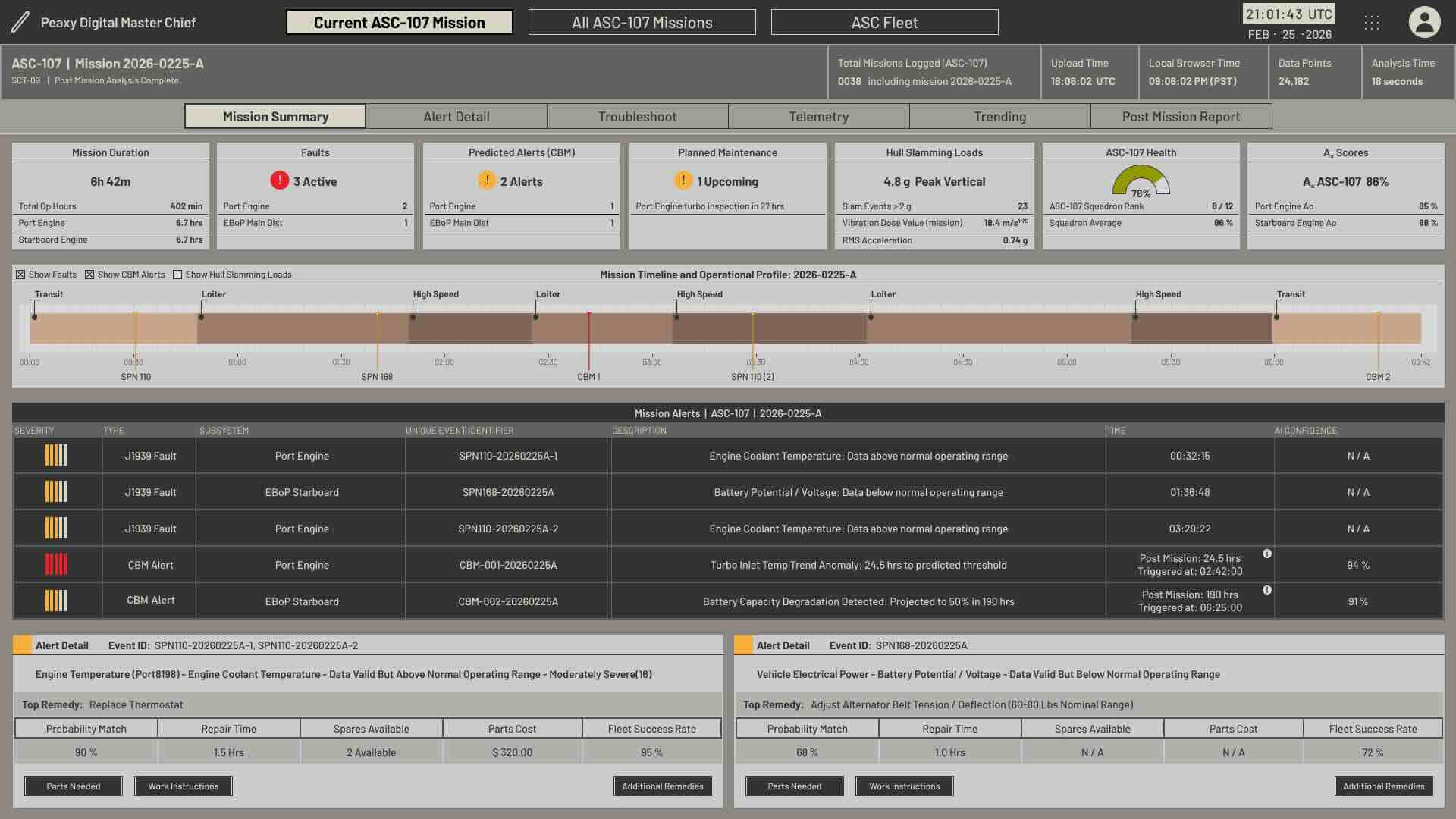
CBM+
ML/AI fault predictions, active fault notifications, periodic maintenance scheduling, and spares inventory tracking — onboard, quayside, and depot.
Playback
Review any time window at up to 4× speed, forward or reverse. Jump to any moment across all monitored systems simultaneously.
System Emulator
Full 3D system emulator with auto or manual mode. Fault injection for realistic training scenarios.
Maintainer Tablet
Real-time system status, predicted and active fault notifications, affected component identification, tech-manual links, and remedy feedback loop.
The same intelligence layer, across the fleet.
The architecture and AI capabilities proven on aircraft carrier and submarine programs are designed to extend across additional naval platforms and defense systems wherever serialized equipment, sensor data, and maintenance readiness intersect.
Power systems, critical machinery, and diesel engines
Condition-based maintenance and predictive fault detection for the propulsion, power generation, and weapons handling systems that drive surface fleet readiness.
CVN · LHA · LHD · BBG · DDG · CCM · CG · LCS · LPD
Port and shipyard power efficiency
Extending energy optimization and data threading capabilities to the shore-based infrastructure that supports fleet maintenance and modernization.
Shipyards · Naval Stations · Depots
Predictive maintenance for unmanned platforms
As the Navy scales autonomous and unmanned systems, predictive maintenance becomes essential for platforms where hands-on repair is not always an option.
USV · UUV · UAV
Supply chain and depot-level maintenance intelligence
Connecting fleet-wide asset data to logistics and supply chain systems — enabling predictive spares positioning, depot planning, and readiness forecasting.
NAVSUP · Depot Maintenance · Fleet Logistics
Ready to discuss your program?
For program offices, fleet maintenance commands, and defense engineering teams operating systems where availability is mission-critical.