

In industries where failure is not an option, for digital twin security, data integrity and operational readiness are inseparable. The digital twin has become a critical bridge between real-world systems and the data ecosystems that sustain them. But as digital twins evolve from static dashboards into predictive, autonomous systems, the challenge has shifted: how do you secure a living model that mirrors—and directly influences—mission-critical operations?
For Peaxy, this challenge is neither theoretical nor new. Over more than a decade of delivering digital twin and data fusion solutions to the U.S. Department of Defense, Department of Energy, and leading industrial operators, the company has built a reputation for threading data through some of the world’s most secure and complex environments.
That culture of trust and rigor for digital twin security was formally recognized in 2025 when Peaxy achieved SOC 2 Type II certification, verified by the Johanson Group, a nationally recognized CPA firm specializing in SOC audits. The certification validated Peaxy’s adherence to stringent standards in security, availability, processing integrity, confidentiality, and privacy.
Lessons in Digital Twin Security from the Fleet: The U.S. Navy
Peaxy’s work with the U.S. Navy onboard systems demonstrates how digital twins can transform both operational reliability and cyber-resilience. These onboard systems are essential to flight-deck operations aboard aircraft carriers. Any downtime can directly impact sortie rates and mission readiness. Working under NIST SP 800-171 and DoD cybersecurity mandates, Peaxy delivered a fully threaded digital twin secure environment that integrated diverse, high-security data sources—ranging from maintenance logs and error codes to real-time sensor data and spare-parts inventories.
Threading Data in a Classified Environment
In most industrial settings, connecting telemetry streams and maintenance data is a challenge of interoperability. In a defense environment, it’s also a challenge of trust boundaries with digital twin security. The Navy digital twin required threading data across air-gapped systems, cyber-accredited devices, and shipboard control environments that operate under strict Authority to Operate (ATO) requirements. Each data handshake had to meet encryption and integrity standards equivalent to those used for classified systems, while remaining performant enough to support 24/7 predictive monitoring and real-time fault detection.
Peaxy’s architecture for this program relied on:
- Edge devices hardened to DoD security standards for data capture aboard vessels.
- Physics-informed emulators modeling onboard systems.
- Condition-based maintenance (CBM) algorithms trained on historical error codes and test events.
- A secure playback and audit layer that allowed authorized engineers to trace any decision, alert, or recommendation back to its data lineage.
The results were tangible:
- Reduced mean time between failures (MTBF) through early identification of component fatigue.
- Faster first-time fix rates using an AI-driven expert system that provided on-the-spot troubleshooting recommendations.
- 24/7 predictive monitoring of 3D-animated models, giving maintainers and command staff a visual understanding of system health in real time.
These outputs focused around increased system resilience and availability (Ao) were achieved by embedding security into every stage of the twin’s lifecycle.
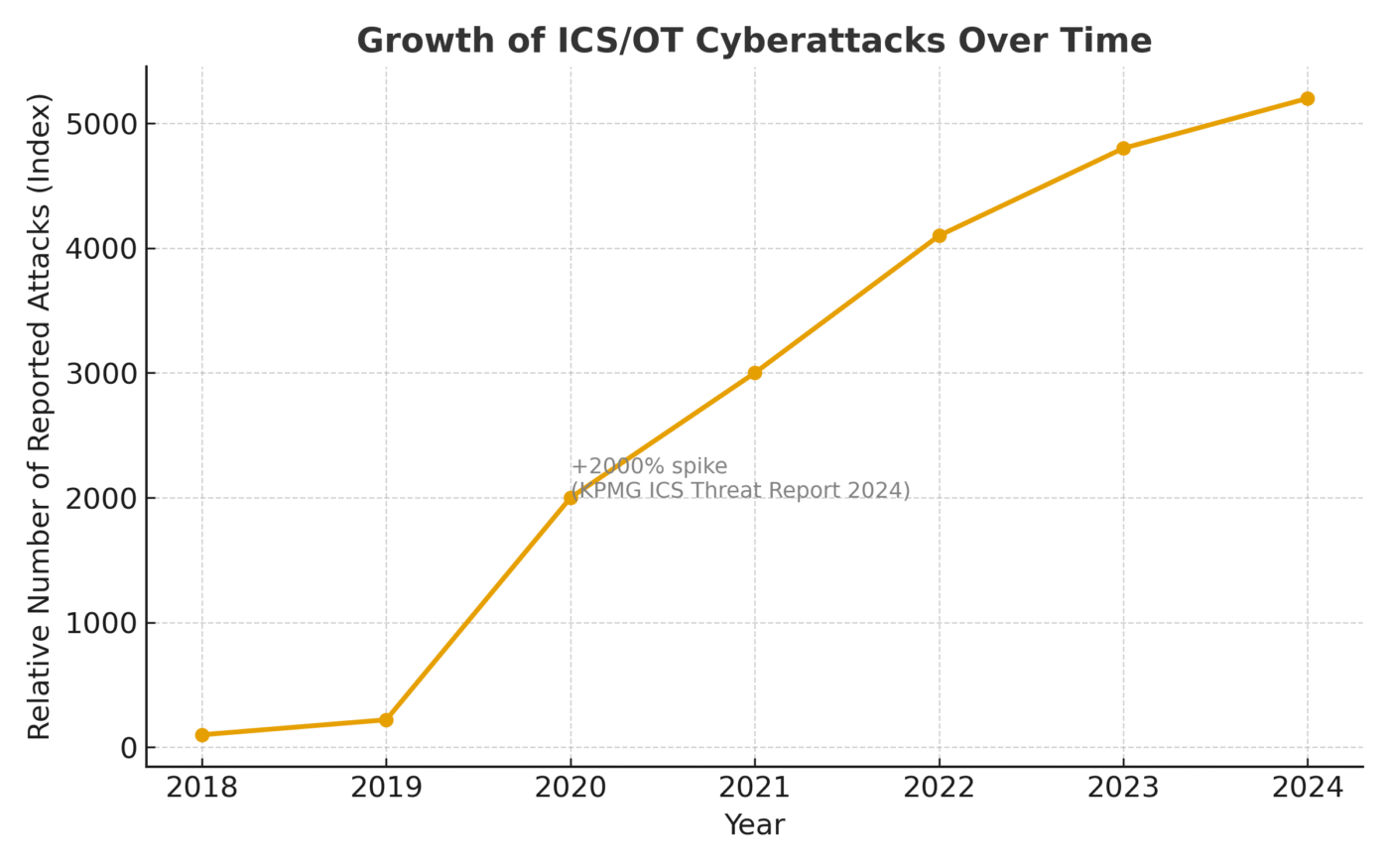
Industrial control system (ICS) and operational technology (OT) cyberattacks have surged more than 2,000% since 2018, reflecting escalating threats to critical infrastructure. Source: KPMG ICS Threat Landscape 2024.
Security by Design: SOC 2 and Beyond
While the Navy project showcased Peaxy’s defense-grade engineering, the company’s SOC 2 Type II certification represents its enterprise-wide codification of those same principles.
The audit assessed Peaxy’s controls over:
- Access management and least-privilege policies
- Data encryption at rest and in transit
- Incident response and monitoring protocols
- Vendor and cloud environment governance
The audit concluded that Peaxy’s operational and infrastructure controls meet or exceed standards required for handling sensitive government and industrial data. The certification aligns with NIST SP 800-171, the U.S. government’s framework for protecting controlled unclassified information (CUI), ensuring that Peaxy’s systems are ready for any DoD or DOE integration.
“Organizations trust us with mission-critical data across energy, aerospace, and defense,” said Peaxy CEO Manuel Terranova in the certification announcement. “This milestone reinforces our promise to deliver scalable digital twin solutions without compromising on compliance or security.”
SOC 2 complements Peaxy’s broader compliance posture—including cyber accreditation for ATO environments and the company’s role as a trusted contractor for many years within the U.S. defense and energy ecosystem.
Where many digital twin vendors focus solely on modeling or analytics, Peaxy stands out by ensuring that data sovereignty, integrity, and traceability are built into the architecture—not bolted on afterward.
Balancing Insight and Confidentiality
A critical dimension of digital twin security lies in balancing the need to share actionable insights along with the imperative to protect proprietary data. In practice, this means designing architectures that allow stakeholders to see only what they are authorized to see. For example, a battery OEM may provide digital twin visibility to customers monitoring fleet performance and state-of-health, but that access must never expose trade secrets such as electrode formulations, process parameters, or yield data.
Peaxy’s data threading framework addresses this through fine-grained data partitioning and role-based encryption, ensuring that each participant receives only the insights relevant to their operational role. This selective exposure model enables collaboration between manufacturers, integrators, and operators—without compromising the intellectual property or competitive advantage that underpin their businesses.
Data Threading Under Constraint: The Engineering Challenge
Digital twins depend on connectivity, but in secure environments, connectivity itself can be a risk. Peaxy’s experience threading data for classified defense programs and critical infrastructure highlights several design principles that apply across industries.
Principle 1: Thread Without Exposure
In conventional enterprise systems, data pipelines may rely on cloud-native services with open API integrations. In contrast, defense and regulated energy projects often prohibit outbound network traffic or external data sharing.
Peaxy’s data fusion architecture uses a modular threading approach: data from sensors, logs, and engineering files are first parsed and normalized locally, then hashed and versioned for integrity. Only metadata and encrypted deltas are transmitted between systems. This allows continuous synchronization without exposing raw operational data—a model that satisfies both cybersecurity and performance requirements.
Principle 2: Enforce Provenance
Every digital twin built by Peaxy maintains immutable data lineage, ensuring that every insight or prediction can be traced to its original source file, timestamp, and validation step. This is particularly critical for defense audits and DOE compliance, where provenance and reproducibility can determine whether a digital record is admissible as an engineering reference.
Principle 3: Design for Air-Gap Parity
For many of Peaxy’s defense deployments, the same software stack must operate across cloud, on-premises, and fully disconnected environments. Achieving functional parity between these modes—so that a model validated on a lab system behaves identically on a shipboard or classified network—requires deep control over both software dependencies and compute orchestration.
Peaxy accomplishes this with containerized deployments and deterministic configuration scripts, ensuring that no runtime drift occurs between environments. In essence, each deployment is a digital twin of the digital twin environment itself.
Digital Twin Security in the Energy Transition
Peaxy’s defense-hardened approach now powers the next generation of energy infrastructure twins, where security and resilience are equally paramount.
From combined-cycle power plants to hydrogen production systems, Peaxy’s digital twin platforms help utilities and OEMs simulate and optimize entire energy ecosystems. These projects often involve critical grid assets whose downtime carries economic and safety risks comparable to defense systems.
Hydrogen Digital Twin
In 2025, Peaxy unveiled an industry-first hydrogen digital twin, capable of modeling full-scale production facilities from 3D geometries to thermodynamic behavior. The system integrates physics-based models of electrolyzers, compressors, and gas storage with economic and degradation models, allowing operators to test configuration scenarios before construction.
Security in this context extends beyond network protection—it includes the integrity of simulation data and compliance with export-controlled technologies. As Peaxy’s SOC 2 report notes, its platform supports confidentiality and availability controls aligned with U.S. Department of Energy standards, ensuring that sensitive process data remains protected even across distributed cloud infrastructures.
Combined Cycle Power Plant Twins
For gas and steam turbine customers, Peaxy’s integrated twin enables real-time performance optimization and 3D visualization of complex assets. The solution combines physics models, climate and degradation models, and costing analytics into a unified workflow that supports secure collaboration among OEMs, EPCs, and utilities.
In both cases, the same secure threading model used in the Navy project applies: data sources—from CAD geometries to sensor telemetry—are validated, encrypted, and versioned within a traceable chain of custody.
This unified architecture allows energy operators to benefit from AI-driven insights while maintaining strict control over who can access or modify the underlying data.
Trust as an Operational Requirement
Security certification and advanced modeling are only part of the equation. For organizations managing fleets of critical assets—be it a carrier group or a grid of turbines—trust must extend through the entire data lifecycle.
As an example with digital twins for the energy industry, Peaxy’s Lifecycle Intelligence platform embodies this concept through three integrated modules:
- Peaxy Innovate™: For secure R&D data capture and model development, ensuring early-stage intellectual property remains protected.
- Peaxy Operate™: For real-time asset monitoring with encrypted telemetry pipelines.
- Peaxy Predict™: For AI-enhanced forecasting and anomaly detection under strict governance policies.
Together, they provide an end-to-end digital thread where data never leaves a controlled boundary, yet remains fully accessible for predictive analytics.
This approach has allowed Peaxy to manage over 550,000 assets under active lifecycle management, with customers spanning the U.S. Navy, Department of Energy, and leading industrial firms in batteries, hydrogen, and power generation.
Lessons for Industry Leaders
The convergence of defense-grade cybersecurity and industrial digitalization offers valuable lessons for any organization deploying digital twins in regulated environments.
Lesson 1: Security Maturity Must Match Operational Complexity
A digital twin that integrates physics, machine learning, and real-time control cannot rely on basic access controls. Every interface—API, dashboard, or sensor feed—represents a potential attack surface.
Peaxy’s experience with SOC 2 and DoD accreditation demonstrates that security maturity must evolve in parallel with model sophistication. The more autonomous a twin becomes, the more critical it is to ensure traceable, auditable decision pathways.
Lesson 2: Compliance Is an Engineering Discipline
Regulatory frameworks like NIST 800-171 or SOC 2 are often viewed as administrative hurdles. Peaxy’s projects show they are engineering enablers. By enforcing rigorous configuration management, change control, and data provenance, these standards make it possible to scale digital twins safely across geographies and domains.
Lesson 3: Hybrid Infrastructures Are the New Normal
The line between cloud and edge computing is blurring. Defense and energy systems require the flexibility to operate in both disconnected and connected states without compromising performance.
Peaxy’s hybrid architecture—capable of cloud scalability and on-prem resilience—illustrates how data threading can coexist with security isolation, providing both agility and assurance.
A Culture of Assurance
A Culture of Assurance
Peaxy’s commitment to security goes beyond compliance checklists. It’s a reflection of its organizational culture, shaped by years of collaboration with partners who measure uptime in mission readiness rather than percentages.
Internally, this means:
- Continuous employee training in CMMC, NIST, and SOC 2 control frameworks.
- Continuous ad hoc and planned efforts monitoring system integrity across customer deployments.
- Design reviews that incorporate both cybersecurity and physical safety considerations.
Externally, it means designing digital twins that serve as trust anchors in complex ecosystems—where data from vendors, operators, and government agencies must coexist securely.
Conclusion: Building the Secure Future of Insight
In both the Navy’s fleet and the energy grid, digital twins are redefining how organizations see, predict, and respond. But insight without assurance can be more dangerous than ignorance.
Peaxy’s journey—from air-gapped ships to cloud-certified infrastructures—demonstrates that the future of digital twins depends on more than algorithms or visualization. It also depends on the ability to build systems where security, availability, and intelligence are inseparable.
As industries embrace digital twins to accelerate the energy transition, improve defense readiness, or optimize infrastructure, one principle stands firm: a twin is only as trustworthy as the data—and the discipline—that sustains it.
Frequently Asked Questions
What does “securing a digital twin” mean?
Securing a digital twin means protecting the data, models, and processes that mirror real-world systems from cyber threats and data corruption. Peaxy achieves this through defense-grade encryption, SOC 2 Type II compliance, and strict access control policies to ensure data integrity and operational reliability.
How is Peaxy’s approach to digital twin security different from others?
Peaxy embeds security from the start rather than adding it later. Its architecture is built on trusted data threading, immutable data lineage, and compliance with NIST 800-171 and SOC 2 standards—principles proven in defense and energy environments where uptime and assurance are mission-critical.
Why is SOC 2 Type II certification important for digital twin platforms?
SOC 2 Type II certification validates that Peaxy’s operational controls meet rigorous standards for security, availability, processing integrity, confidentiality, and privacy. It signals to customers in defense, energy, and infrastructure that their mission-critical data is handled with the highest assurance.
How does Peaxy protect data in air-gapped or classified environments?
Peaxy uses a modular threading architecture that allows synchronization without exposing raw operational data. Metadata and encrypted deltas are transmitted instead, enabling continuous updates while maintaining compliance with Department of Defense and Department of Energy cybersecurity mandates.
Can the same secure architecture be applied outside of defense?
Yes. The same security principles used in Peaxy’s naval and defense programs now underpin digital twin deployments for hydrogen systems, power plants, and industrial fleets. This ensures reliable, auditable insights across all sectors undergoing digital transformation.