

In the rapidly evolving field of battery manufacturing, data-driven decision making in battery manufacturing is proving to be a competitive differentiator. Consider a simple scenario where a battery manufacturer identifies a recurring defect in their production line, but they don’t know precisely where and have to discard defective cells as they come off the line. By leveraging real-time and offline data analytics, original equipment manufacturers (OEMs) can pinpoint the exact stage where the defect occurs, analyze the root cause, and implement corrective steps with measurable impacts. This not only improves the quality of the batteries but also reduces waste and enhances overall efficiency. In this article, we’ll take a look at five ways that data-driven decision making can positively impact battery manufacturing.
The Importance of Data-Driven Decision Making
Battery manufacturing is a complex process that can involve sourcing material, slurry mixing, coating, drying, calendering, slitting, vacuum drying, fabrication (jelly roll winding or stacking), welding, packaging, electrolyte filling, formation, and aging. Each stage generates a vast amount of data that, if harnessed correctly, can provide valuable insights into production efficiency, quality control, and cost management throughout the lifecycle.
Data-driven decision making in battery manufacturing enables companies to make informed choices based on real-time and offline data analytics. This leads to improved product quality, reduced production costs, and faster time-to-market.
Studies by Siemens and Accenture found that implementing data-driven practices in battery manufacturing can lead to a 10.3% reduction in material scrap rates and a 7.2% increase in machine uptime[1]. Predictive maintenance enabled by data analytics can also reduce energy consumption by 9.3%, translating into significant cost savings and environmental benefits.[2]
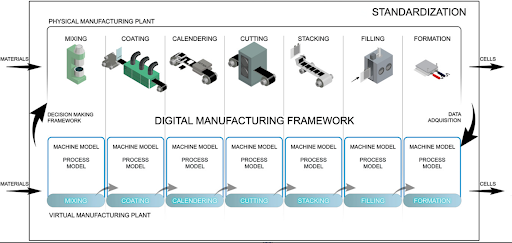
A typical manufacturing process for lithium ion batteries, including electrode preparation, cell assembly, cell formation and finishing, can produce enormous amounts of data that can only be practically managed with a data analytics solution. Source
Five Challenges Faced by OEMs
OEMs in the battery industry face the following five challenges that can be mitigated through data-driven decision making:
- Quality Control: Variations in raw materials, processes, and environmental conditions can lead to defects. Data analytics helps monitor variables in real-time, allowing for immediate adjustments.
- Scalability: With the demand for EVs and energy storage growing, OEMs must scale operations. Data-driven insights optimize complex processes and maintain quality.
- Cost Management: By analyzing production data, OEMs can reduce costs tied to materials, labor, and energy consumption.
- Supply Chain Management: Data analytics enhances supply chain visibility, enabling tracking of raw materials, inventory, and logistics disruptions.
- Regulatory Compliance: Compliance with environmental and safety regulations requires transparency. Tools like the Battery Passport depend on data analytics for lifecycle traceability.
Addressing the Challenges with Peaxy Build
Peaxy Build is a comprehensive software platform designed to address these challenges. Its standout feature, the “manufacturing traveler,” threads data across every stage of the production process. This capability provides the foundation for data-driven decision making in battery manufacturing.
Enhanced Quality Control
Manufacturers can monitor key production variables and quality KPIs such as yield, cycle life, charge time, and energy density per cell. Real-time monitoring ensures consistent quality, reduces scrap, and lowers warranty claims.
Optimized Scalability
Peaxy Build collects and threads manufacturing data, enabling machine learning models to predict cell performance early in the process. This is essential when scaling production efficiently.
Cost Efficiency
Analytics capture data on material usage, energy consumption, and labor efficiency. Insights from this data reduce waste, improve energy efficiency, and enhance yield—all contributing to more sustainable production.
Supply Chain Visibility
Integrated with ERP systems, Peaxy Build enhances visibility into material sourcing, logistics, and inventory. Predictive analytics can flag disruptions before they escalate, allowing proactive action.
Regulatory Compliance
By capturing and analyzing critical production data, manufacturers ensure compliance with environmental and safety standards. Integration with the Battery Passport supports ethical sourcing and transparency.
Statistical Process Control in Battery Manufacturing
Statistical Process Control (SPC) is an increasingly important technique in maintaining quality. SPC uses statistical methods such as control charts to monitor variations in production metrics like electrode coating thickness or electrolyte concentration.
By identifying when processes deviate from expected performance, SPC enables timely interventions. This structured approach maintains high standards, reduces defects, and ensures long-term process stability.
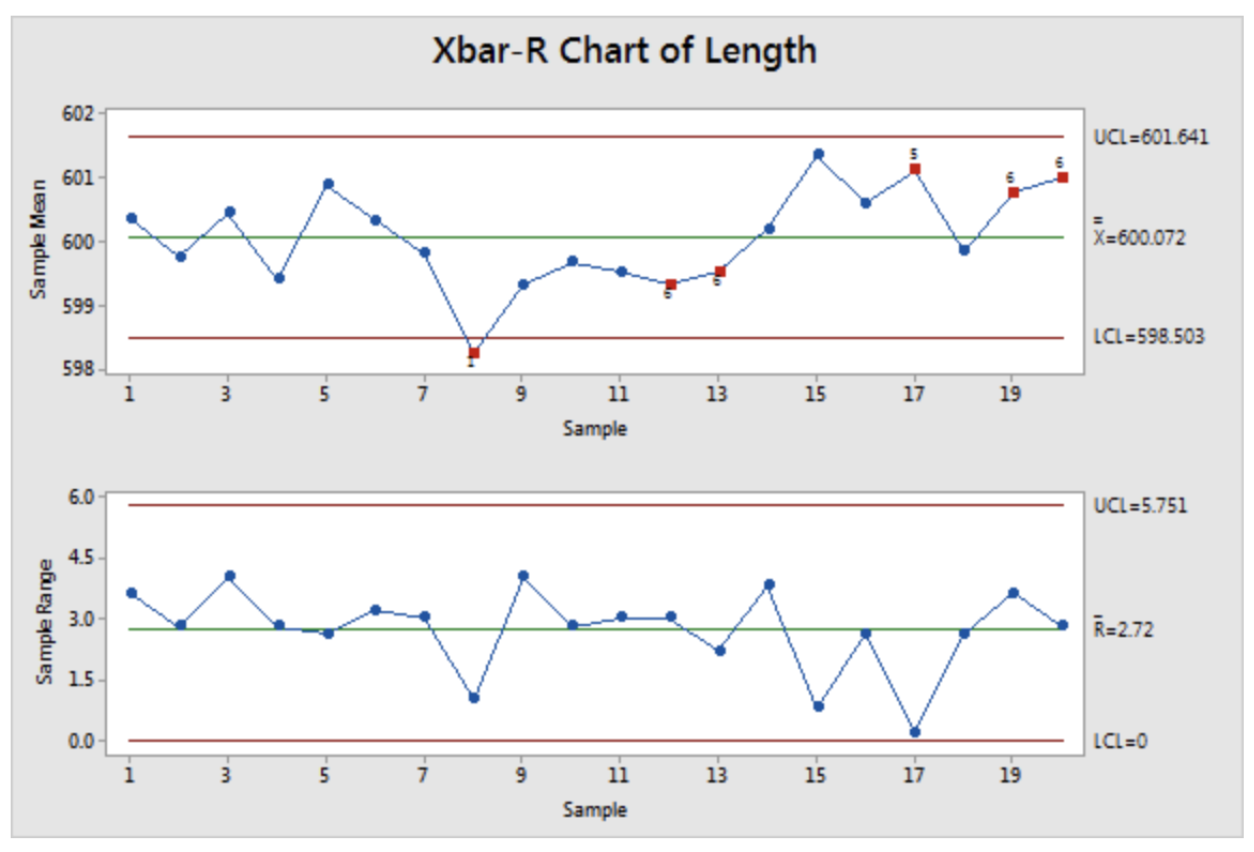
Statistical Process Control (SPC) is crucial in battery manufacturing, using control charts, for example, to monitor production quality in real-time. By identifying variations and ensuring processes stay within control limits, SPC helps maintain high standards and reduce defects.
For example, a control chart might use formulas like the mean and standard deviation to establish upper and lower control limits (UCL and LCL). These limits help identify when a process is deviating from its expected performance, allowing for timely interventions. In addition to ensuring a process is stable, control charts can also determine whether improvements should target non-routine events or the underlying process itself. Process capability indices like Cp and Cpk measure how well a process can produce output within specified limits, providing insights into overall process stability. In summary, implementing SPC is a controlled, systematic method to determine the difference between normal process variability and anomalies that need immediate attention.
Conclusion: The Future of Data-Driven Battery Manufacturing
Peaxy Build addresses the key challenges faced by OEMs through advanced analytics and manufacturing traveler capabilities. By capturing critical data at every step of the production process, it empowers data-driven decision making in battery manufacturing. The result is enhanced quality control, optimized scalability, improved cost efficiency, stronger supply chain visibility, and reliable compliance.
This comprehensive approach ensures that battery manufacturers remain competitive and meet the rising global demand for safe, high-quality batteries.
Frequently Asked Questions
What is data-driven decision making in battery manufacturing?
It’s the use of real-time and offline production data to pinpoint defects, identify root causes, and take corrective actions that measurably improve quality, cost, and time-to-market.
How does Peaxy Build enable data-driven decision making?
Peaxy Build threads data across every step via a “manufacturing traveler,” unifying metrology, formation, and performance data so teams can monitor KPIs, spot issues early, and act on insights in real time.
Which manufacturing challenges benefit most from data analytics?
Five big ones: quality control, scalability, cost management, supply-chain visibility, and regulatory compliance (including support for Battery Passport traceability).
What role does Statistical Process Control (SPC) play?
SPC applies control charts and capability indices (e.g., Cp/Cpk) to distinguish normal variation from anomalies, enabling timely interventions that reduce defects and keep processes in control.
Can analytics improve compliance and sustainability?
Yes. By capturing the right data at each step, manufacturers can trace materials, prove conformance, cut scrap and energy use, and prepare evidence for audits and Battery Passport requirements.
References
[1] Siemens and Accenture: Data-driven approach for modern battery …
[2] The Power of Digitalization in Battery Cell Manufacturing
[4] How Digital Solutions are Propelling Battery Manufacturing – METTLER TOLEDO
[5] Tata Elxsi – Battery passport: Revolutionizing lifecycle management …