

Updated December 1, 2025
Battery passport global relevance is becoming clear as regulators, manufacturers, and consumers push for greater transparency in the battery value chain. What began as a European initiative now has worldwide implications, including in the United States. The passport provides a digital record of a battery’s lifecycle, from raw material extraction to recycling. With it, sustainability, traceability, and ethical practices can be verified at every stage.
The European Battery Passport Initiative and Global Relevance
The European Union’s battery passport regulation, approved in June 2023, requires all batteries sold in the EU to include a digital passport. This passport contains detailed information on a battery’s environmental footprint, material origin, and lifecycle performance.
The regulation’s goals are ambitious. It aims to improve traceability, enhance sustainability, and make recycling easier. By embedding lifecycle data in every unit, the EU has set a global benchmark. This example shows why battery passport global relevance extends far beyond Europe.
Environmental, Social, and Governance Benefits
Environmental performance
The passport helps manufacturers track lifecycle impacts such as carbon footprint, energy use, and recycling efficiency. For example, it highlights recycled content use, which reduces reliance on virgin resources and ensures compliance with emission standards.
Social performance
The passport promotes ethical sourcing and fair labor practices. It verifies that raw materials are not linked to child labor or unsafe working conditions. This transparency builds trust with consumers and reduces supply chain risks.
Governance performance
The passport also supports corporate accountability. It includes data on anti-corruption efforts and responsible sourcing policies. In this way, battery passport global relevance extends beyond environmental and social issues to include governance and ethical operations.
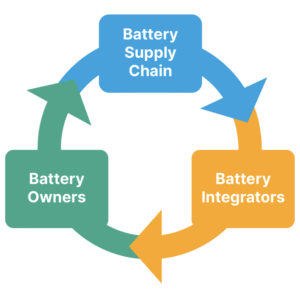
The circular value chain for batteries is a crucial concept in the battery passport initiative. It illustrates the full lifespan of a battery from raw materials, to manufacture, field deployment and eventual recycling, where some of the materials captured go back into new batteries. Battery analytics capabilities are critical along the entire value chain to address security, safety, sustainability and profitability.
Battery Passport Global Relevance in the U.S. Market
Although the U.S. does not yet require a battery passport, momentum is growing. Efforts like the “Track and Trace” program and the Li-Bridge collaboration show a move toward standardized data transparency. These initiatives aim to strengthen competitiveness and sustainability, echoing the EU’s goals.
The challenge of data interoperability
One of the largest obstacles is data interoperability. Manufacturers, recyclers, and regulators each use different systems. Integrating data across these systems is difficult.
Peaxy addresses this challenge with advanced data threading. The technology connects battery data from sourcing, manufacturing, operations, and recycling. As a result, U.S. companies can prepare for the rising battery passport global relevance.
Peaxy’s Role in Supporting the Battery Passport
Peaxy’s software suite—Innovate, Build, Operate, and Predict—provides end-to-end lifecycle visibility. From cell formation to disassembly, Peaxy enables companies to capture and analyze battery data.
One customer active in both manufacturing and recycling illustrates this. By using Peaxy’s solutions, the company tracks each battery’s complete lifecycle. This improves efficiency and ensures readiness for new regulations tied to battery passport global relevance. Routine battery health checks are another way to extend performance and improve second-life applications.
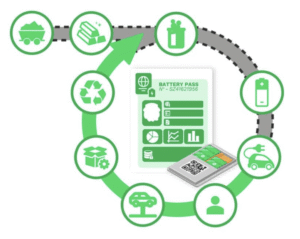
[Credit: NFCW]
Efforts are underway to establish a standardized system for tracking key indicators along the battery supply chain, driven by the need for sustainability and transparency. The Li-Bridge Initiative, involving over 50 companies and government agencies, aims to enhance supply chain understanding and efficiency through comprehensive tracking and tracing of lithium batteries.
Tangible Benefits for Companies
Companies that adopt the passport framework can gain operational and financial advantages.
Yield optimization
Redirect borderline batteries into second-life applications. This reduces scrap, saves costs, and maximizes value from each unit.
Quality feedback loops
Analyze fleet battery data to identify degradation patterns. Use this insight to improve designs and reduce failure rates.
Design for disassembly
Integrate modular design early. This simplifies reuse and recycling, lowering time and costs at end of life.
Circularity-driven procurement
Make sourcing decisions with second-life and recyclability in mind. This enhances both sustainability and long-term profitability.
Each of these examples shows how battery passport global relevance supports a more circular battery economy.
Conclusion: Why Battery Passport Global Relevance Matters
The battery passport global relevance is undeniable. What began as a European regulation is shaping global expectations for sustainability, traceability, and accountability. For U.S. companies, preparing now is essential to remain competitive.
Peaxy’s expertise in battery lifecycle intelligence ensures companies can integrate seamlessly with evolving passport standards. Manufacturers that adopt data-driven decision making will be better prepared to meet evolving regulations. By adopting these practices early, businesses improve compliance, increase efficiency, and unlock long-term value.
Frequently Asked Questions
What is the purpose of the battery passport?
The battery passport creates a digital record of each battery’s lifecycle. It improves transparency by documenting sourcing, manufacturing, usage, and recycling data, ensuring compliance with sustainability and traceability regulations.
Why is battery passport global relevance important?
While the passport started as a European Union initiative, it influences global markets. Manufacturers in the U.S. and beyond must prepare for similar requirements to remain competitive in supply chains and meet customer expectations.
How does the battery passport support sustainability?
It helps companies measure carbon footprint, track recycled content, and design for disassembly. These insights enable circular economy practices that lower costs and reduce environmental impact.
What role does Peaxy play in the battery passport initiative?
Peaxy provides advanced data threading solutions that connect information from sourcing through recycling. This end-to-end visibility supports compliance, optimizes performance, and addresses the challenges of data interoperability.
Is the battery passport mandatory in the United States?
Not yet, but U.S. initiatives like Li-Bridge and “Track and Trace” are moving in that direction. Companies that prepare early gain an advantage in compliance readiness and supply chain competitiveness.