

Updated December 4, 2025
One of the major battery energy storage safety hazards is thermal runaway, which is a rapid uncontrolled release of heat energy from a battery cell. This can result in a chain reaction that heats up neighboring cells and releases hot flammable and toxic gasses, which can ignite and cause a fire or explosion that can spread to other parts of the system.
Thermal runaway can be triggered by mechanical damage, electrical faults or overheating of the battery. Another cause is improper charging or handling of the batteries, which can lead to short circuits or overcharging. A common factor that contributes to the intensity and difficulty of extinguishing battery energy storage fires is the presence of flammable electrolytes in the lithium-ion cells. These electrolytes fuel the fire and make it resistant to water or conventional fire suppressants.
According to FEMA, in April 2019, a battery energy storage safety hazard caused an unexpected explosion of batteries on fire in an Arizona energy storage facility injured eight firefighters. Another report released by APS in July 2020 stated that the fire and explosion at the McMicken Energy Storage facility was caused by an internal cell defect in one of the lithium ion batteries, which triggered a cascading thermal runaway event1. The report also found that the firefighters did not have a proper response plan for dealing with the battery fire, and that the fire suppression system was inadequate for the size and nature of the fire2. It recommended several safety measures for future battery installations, such as improved fire detection, ventilation, and isolation systems3.
A real-life example of a battery energy storage safety hazard
This year alone has seen at least 9 instances of fires4 at battery energy storage facilities, raising concerns about safety around this emerging technology. According to media reports, at least four major incidents have occurred in New York, California and Arizona, involving lithium-ion batteries that overheated and ignited. These fires have prompted state authorities to launch investigations and create fire safety working groups to evaluate the causes and effects of the battery storage fires, as well as to review the existing codes and standards for energy storage systems. They have also highlighted the need for more public awareness and emergency preparedness around battery storage facilities, especially as they are expected to play a key role in the transition to a clean energy future.
To prevent or reduce the risks of these hazards, BESSs need to have proper detection and protection systems in place. These systems include fire detection and suppression, gas detection and ventilation, thermal management and monitoring, electrical isolation and grounding, emergency disconnects and signage, personal protective equipment, and emergency response plans. Additionally, BESSs need to comply with relevant codes and standards, such as NFPA 855, UL 9540, and IEEE 1547.
One important way to enhance the safety of BESSs is to smartly use battery analytics that can provide insights into thermal problem areas by monitoring voltage and heat at the battery cell level. This can help identify potential failures before they escalate into thermal runaway or other hazardous scenarios. Our own battery analytics solution, Peaxy PLI (Predictive Lifecycle Intelligence), can address provides features such as:
Real-time monitoring of battery health and performance
Real-time monitoring of battery health and performance is a key feature of a battery analytics solution to enable battery owners and operators to track the status of their batteries, identify potential issues, optimize performance, and extend battery life. Monitoring can provide valuable insights into the battery’s voltage, temperature, current, power, state of charge, and state of health. By analyzing these parameters, users can detect anomalies, diagnose faults, prevent failures, and optimize charging and discharging cycles, staying within manufacturer guidelines to avoid warranty issues. Battery monitoring can also help users reduce operational costs, improve safety, and enhance customer satisfaction. A battery analytics solution such as PLI that offers real-time monitoring can provide a competitive edge and direct revenue impact.
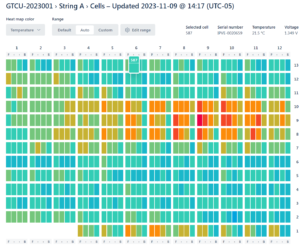
PLI (Peaxy’s battery analytics solution) can integrate with any existing data infrastructure and collect data from various sources, such as R&D labs, manufacturing plants, hardware integration systems, grid services, and transportation fleets. This data is then made available through a user-friendly interface that allows users to access and visualize their battery data in real time, in a few clicks, and in a much easier way than creating a one-off bespoke application or dealing with more limited and generalized off-the-shelf graphing tools. In this example, battery owners and operators can view live data about temperature and voltage down the individual cell level.
Early warning of anomalies and degradation with battery energy storage safety hazards
Early warning of anomalies and degradation is a crucial feature of any battery monitoring solution. By detecting and reporting any abnormal behavior or performance decline of the battery system, such as voltage imbalance, temperature rise, capacity loss, or internal resistance increase, a battery monitoring solution can help prevent costly failures, extend battery life, and optimize energy efficiency.
PLI offers early warning of anomalies and degradation using advanced algorithms and a comprehensive data model that can pull in data from multiple vendors and systems. PLI’s solutions can monitor various types of batteries, such as lead-acid, lithium-ion, nickel-cadmium, and nickel-metal hydride, and provide real-time data in the form of point and click interactive reports and alerts. PLI’s solutions can also integrate with other systems, such as energy management, asset management, or predictive maintenance, to enable a holistic approach to battery health and performance.
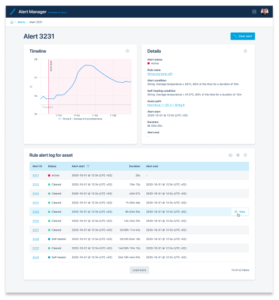
Peaxy’s PLI Alert Manager allows battery owners and operators to set user-defined alerts on any BMS parameter, pricing or weather parameter. Alerts that are created are available in a single view, so that they can be easily reapplied to any asset. Intuitive alerting is provided with a summarized view, and click-through detailed alert information to view full details including parameter trending.
Predictive maintenance and optimization
Battery analytics is essential for ensuring the safety, reliability, and efficiency of a BESS. Predictive maintenance combines data analytics, machine learning algorithms, and real-time monitoring to detect potential faults and predict failures before they occur. This reduces the risk of unexpected downtime, costly repairs, and hazardous incidents.
Optimization in battery analytics involves using data-driven models and algorithms to adjust the charging and discharging patterns of batteries according to the grid conditions, demand patterns, and environmental factors. This maximizes the performance and lifespan of batteries, as well as the economic and environmental benefits of BESS. By implementing predictive maintenance and optimization in battery analytics, BESS operators can improve the quality and availability of power, enhance the integration of variable renewable energy sources, and support the decarbonization of the energy sector.
Data visualization and reporting
Data visualization and reporting are essential tools for battery analytics, as they can help to reveal insights, identify anomalies, monitor performance, and satisfy regulatory obligations. Some of the benefits include:
-
Data visualization reveals insights that tables can’t—highlighting differences in operating conditions across energy blocks or strings, exposing discrepancies, and enabling multi-level drill-downs from site to cell with synchronized timelines to spot trends or anomalies instantly.
-
Dynamic charting tools like PLI can rapidly process gigabytes of data, allowing users to zoom, filter, and explore live performance indicators in real time for clearer situational awareness and faster investigation.
-
Automated data reporting produces full-resolution plots that capture every data point for archival accuracy, regulatory compliance, and historical performance analysis, while helping stakeholders—from R&D to operators—interpret complex battery analytics and make better decisions.
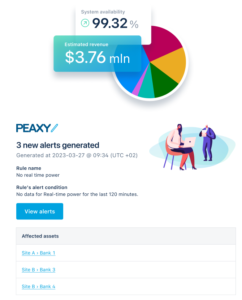
Peaxy’s battery analytics includes automated customizable financial reporting that allows battery owners and operators to create automated performance reports for financial and technical insights daily, weekly and monthly for each BESS. Users can also configure formats, template and delivery options for employees, customers, regulators and others, and create custom reports with calculations on demand across any time period. Alerts can be set on report outputs such as energy mix change, system availability drops and out-of-warranty operating conditions.
The takeaway
BESS safety is a critical issue that affects the future of clean and resilient energy. As the number of BESS installations increases, so does the need for a heightened understanding of the hazards involved and more extensive measures to reduce them. Peaxy’s PLI battery analytics solution can help BESS operators achieve this goal by providing them with actionable insights into their battery systems.
Frequently Asked Questions (FAQ)
What are the most common battery energy storage safety hazards?
Common battery energy storage safety hazards include thermal runaway, internal short circuits, overcharging, rapid temperature rise, gas venting, electrolyte leakage, and electrical or mechanical faults within cells, modules, or the larger ESS enclosure. These risks can escalate quickly without proper monitoring.
How can battery analytics improve safety in energy storage systems?
Battery analytics improve safety by detecting early signs of abnormal behavior—such as rising internal resistance, unexpected voltage drop, unbalanced cell groups, or temperature anomalies—long before they become dangerous. Early detection allows operators to intervene proactively and prevent hazardous conditions.
What role does thermal monitoring play in preventing ESS safety incidents?
Thermal monitoring helps identify hotspots, cooling system failures, and cell-to-cell thermal propagation risks. When paired with analytics, operators can distinguish between normal temperature variation and genuine early-warning signals of thermal runaway.
Can battery analytics help reduce the risk of thermal runaway?
Yes. Battery analytics identify precursors to thermal runaway, such as accelerated impedance growth, uneven charging behavior, or abnormal heating patterns. Detecting these patterns early enables operators to isolate affected modules, adjust operating conditions, or schedule maintenance to prevent escalation.
Why do some safety hazards go unnoticed without analytics?
Traditional monitoring often relies on threshold-based alarms that trigger only when parameters exceed preset limits. Battery degradation and failure modes frequently develop gradually and may remain hidden within “normal” ranges. Analytics reveal underlying trends and subtle deviations that conventional monitoring would miss.
How do safety insights support regulatory compliance and insurance requirements?
Detailed analytics and historical data help operators prove that their systems are being operated safely and within specification. This documentation supports regulatory audits, warranty claims, and insurance evaluations, reducing liability and improving operational transparency.
Do analytics help with incident response after a safety event?
Yes. Analytics provide a timestamped record of system behavior before, during, and after an event. This data accelerates root-cause analysis, helps prevent repeat incidents, and supports collaboration with OEMs, regulators, and insurers.
Can battery analytics improve safety across a fleet of ESS installations?
Absolutely. By comparing behavior across multiple sites, operators can identify systemic risks, track recurring failure patterns, and apply best practices fleet-wide. This leads to more consistent safety performance across all installations.
1 Report shows cause of APS explosion that hospitalized … – ABC15 Arizona. https://www.abc15.com/news/region-west-valley/surprise/new-report-reveals-what-caused-aps-battery-explosion-that-hospitalized-eight-firefighters.
2 APS battery explosion in Arizona: New report tells what went wrong. https://www.azcentral.com/story/money/business/energy/2020/07/27/aps-battery-explosion-surprise-new-report-findings/5523361002/.
3 Arizona battery fire’s lessons can be learned … – Energy-Storage.News. https://www.energy-storage.news/arizona-battery-fires-lessons-can-be-learned-by-industry-to-prevent-further-incidents-dnv-gl-says/.
APS completes investigation following 2019 battery storage fire disaster. https://www.smart-energy.com/regional-news/north-america/aps-completes-investigation-following-2019-battery-storage-fire-disaster/.
4 https://storagewiki.epri.com/index.php/BESS_Failure_Event_Database