
The story of every battery begins long before a cell is assembled. It starts in the lab, where powders are blended, slurries are mixed, precursors are tested, and electrodes are prepared. These early steps determine how well a battery will perform, how long it will last, and whether it will stand up to real-world stress. Yet the insights that matter most at this stage are often scattered across instruments, spreadsheets, and disconnected file systems. As a result, materials scientists can spend more time searching for data than understanding what it means.
Modern analytics changes that dynamic. By threading metrology data across the battery R&D workflow, labs can see patterns that were previously hidden and make decisions based on a complete picture rather than isolated measurements. Metrology becomes more than a collection of tests, as a connected, continuously growing foundation for lifecycle intelligence.
Why Metrology Data Matters Long Before a Cell Exists
Metrology is the earliest and often most accurate predictor of battery performance. Measurements such as XRD reveal the crystalline structure of a material, while TGA exposes thermal stability and decomposition behavior. iCAP-OES provides a precise look at elemental composition, and BET analysis captures surface area and porosity—two characteristics that heavily shape ion transport. Microscopy, whether optical or electron-based, uncovers the morphology and coating uniformity that ultimately influence power capability and degradation.
These datasets, taken together, describe the DNA of a battery material. But when each result lives in its own folder, or when researchers manually compile values into a spreadsheet without context, the broader story disappears. The earliest signals of success or failure become easy to miss, and the cost of those blind spots only grows as development progresses.
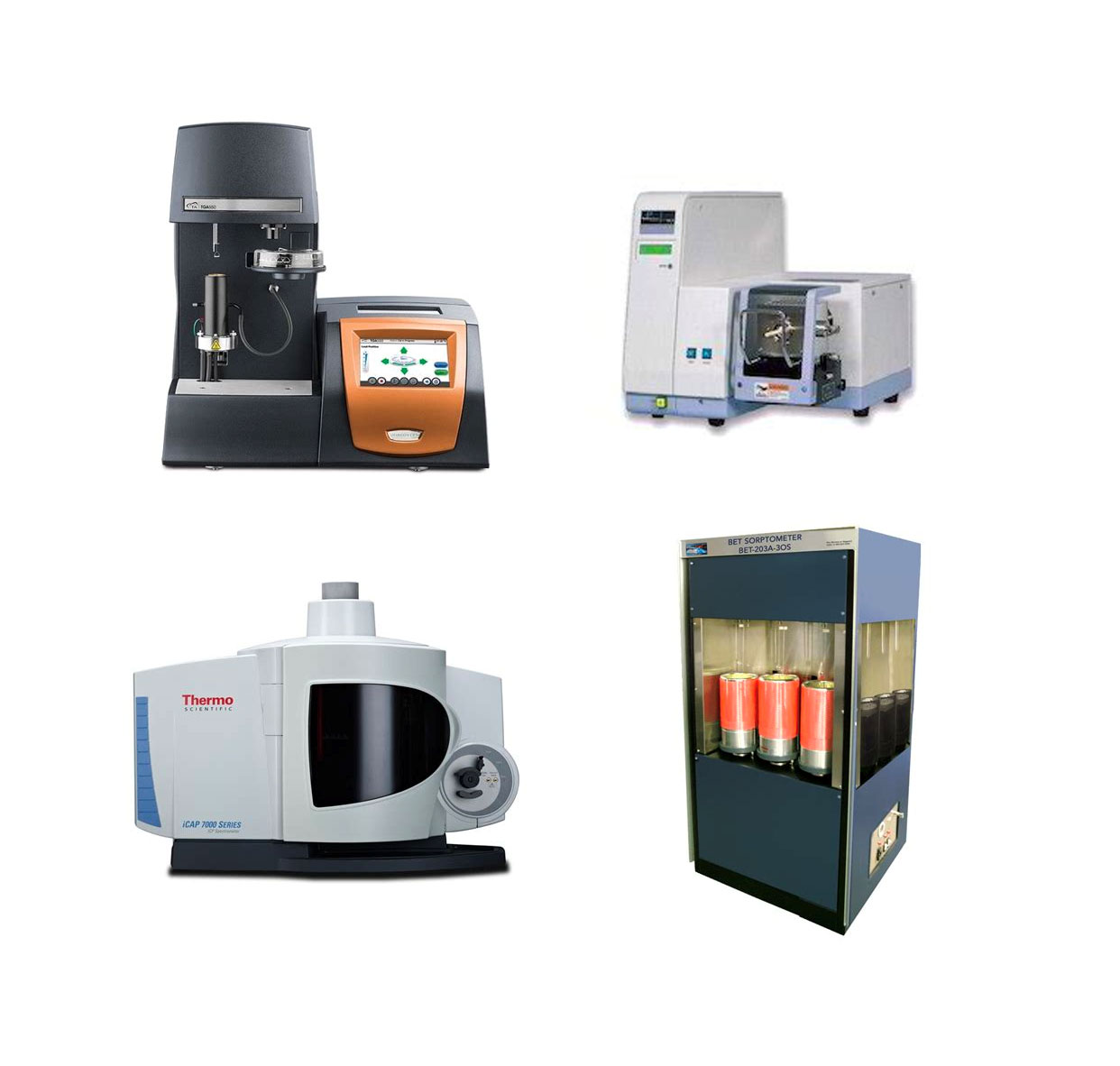
Some of the instruments whose data is captured: X-ray Diffraction, TGA, iCAP-OES & BET. Data produced from these tools can be used to automate a multi-step process refinement and parameter check workflow. The totality of this serialized data can later be referenced downstream after the battery is manufactured and in service in the field to extend useful life and improve performance.
How Analytics Strengthens Metrology Workflows
The first step analytics brings to metrology is simple but transformative: automatic data capture and standardization. Instrument outputs flow directly into a unified platform where filenames, formats, and metadata are handled consistently. Researchers no longer waste time renaming files, hunting for missing measurements, or manually transcribing values. This alone improves accuracy and frees teams to focus on interpretation rather than administration.
The real value appears once these measurements are connected to downstream results. With data threading, a viscosity measurement taken during slurry preparation can later be tied to coating uniformity. The morphology observed under a microscope can be correlated with thermal behavior seen in TGA results. Elemental impurities identified through spectroscopy can be linked to cycle-life outcomes months later. Instead of treating each measurement as an isolated point, analytics lets teams see how one stage influences every stage that follows.
Long-term benefits of metrology analytics
Over time, this creates a feedback loop that shortens the entire R&D cycle. Researchers can identify which material combinations consistently lead to strong performance and which ones correlate with early failures. Statistical and machine-learning tools highlight trends and anomalies that may not be visible to the naked eye. Decisions that once required lengthy rounds of trial and error now emerge from patterns in the data.
Analytics also strengthens reproducibility and quality control. Because metrology is so sensitive to changes in process conditions, drift in an instrument, or variations in supplier inputs, inconsistencies can ripple through future experiments. With threaded data, labs can spot these variations early, compare batches side-by-side, and detect deviations long before they affect cell performance.
Perhaps most importantly, the insights gained during metrology do not disappear once a battery leaves the lab. High-resolution material and structural data greatly improve the accuracy of digital twins used during formation, cycling, deployment, warranty modeling, and even recycling. The more detailed the early-stage measurements, the more predictive the models become throughout the battery’s life.
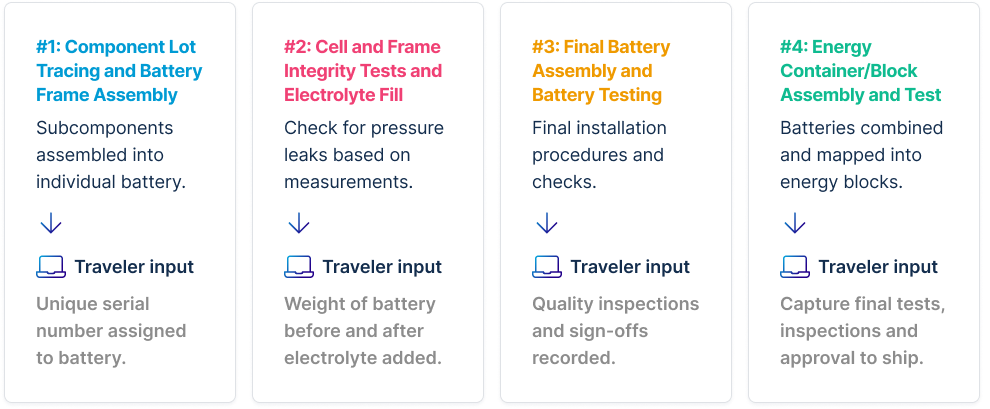
By capturing metrology data from materials before a battery is even built, it becomes possible to query and associate downstream life cycle data with parameters of the materials that went into the battery, in a fully automated fashion.
Why Metrology Benefits from Data Threading
Metrology produces some of the most valuable data in the entire battery lifecycle, but the lack of context is often the biggest barrier to using it effectively. Data threading solves this by linking every experiment, measurement, and sample back to its source. A TGA profile is no longer just a thermal curve—it is connected to a batch, a synthesis route, an electrode recipe, a formation profile, and ultimately to real-world performance.
With that foundation, labs can see not just what a material is, but how it behaves over time. They can ask better questions and uncover clearer answers: Which suppliers deliver the most consistent precursors? Which active materials produce the most stable electrodes? Which failure modes originate from early-stage variations that were previously overlooked?
By carrying metrology insights forward, data threading builds continuity across the entire battery lifecycle. It prevents early knowledge from being lost and ensures that decisions made in the lab scale predictably into pilot lines, gigafactories, and field deployments.
Conclusion
Every battery’s success depends on choices made long before it powers a device or stores a megawatt of energy. Metrology offers the earliest and most detailed view of material behavior, but its full potential is unlocked only when analytics and data threading bring its results together. When labs connect their measurements, standardize their workflows, and trace data across the lifecycle, they gain faster insights, tighter reproducibility, and a deeper understanding of how to build better batteries. Analytics gives metrology a memory—and with it, a far greater impact on the batteries of tomorrow.
For more insights into how threading serialized battery data can reduce risk and increase performance, please see our previous article: The importance of battery lot traceability.
Frequently Asked Questions
What is metrology in battery R&D?
Metrology refers to the measurement and analysis of materials used in batteries, including their structure, composition, morphology, and stability. It provides early indicators of how a battery will perform once assembled.
How does analytics improve metrology workflows?
Analytics automates data capture, standardizes formats, and links instrument outputs to later stages of development. This helps researchers interpret data more quickly and make clearer, evidence-based decisions.
Why is connecting metrology to downstream performance important?
Material properties measured early in R&D often predict coating behavior, thermal stability, power capability, and degradation rates. Connecting these datasets reveals relationships that guide better material and process decisions.
Can metrology data support digital twins?
Yes. Early measurements improve digital twin accuracy because they ground models in real material properties and process conditions that persist throughout the battery’s life.
How does data threading increase reproducibility?
Data threading provides traceability across samples, batches, and process steps. This makes it easier to identify variations, detect instrument drift, and maintain consistency across experiments.