Updated November, 2025
Editor’s Note: Peaxy recently announced an exciting development in digital twins for the energy industry, specifically for hydrogen power plants, in partnership with Baker Hughes. Please see “Peaxy’s Experience with Digital Twins” below for details.
Digital twins are transforming industries by providing virtual replicas of physical systems to simulate real-world performance. From aerospace to energy, they are changing how organizations design, operate, and maintain assets. Not surprisingly, digital twins in battery analytics are emerging as a breakthrough, offering unprecedented insights into performance and lifecycle optimization. By creating a virtual model of a battery or battery energy storage system (BESS), companies can optimize plant design, monitor operations in real time, and improve predictive maintenance.
This article explores the practical applications of digital twins in battery analytics and highlights how they are reshaping the future of battery management systems.
What Are Digital Twins in Battery Analytics?
A digital twin is a virtual model designed to mirror the state and behavior of a physical system. In the context of batteries, it continuously collects and analyzes data from embedded sensors that measure voltage, current, temperature, and other variables.
With these data streams, digital twins simulate real-world conditions and provide valuable insights into performance, degradation, and potential risks. This makes digital twins in battery analytics essential for manufacturers, operators, and asset managers who want to reduce downtime and extend the lifespan of their systems.
Real-Time Monitoring and Diagnostics
One of the biggest advantages of digital twins is real-time monitoring. By collecting sensor data continuously, a digital twin can detect anomalies such as unexpected voltage drops or rapid temperature increases. Early detection allows teams to take corrective action before failures occur.
Battery safety is especially critical in applications like electric vehicles (EVs) and grid energy storage. Digital twins can detect signs of thermal runaway—an event that can lead to fires—by identifying abnormal patterns early. They can also simulate stress scenarios to confirm that a battery meets safety standards before deployment.
Solutions like Peaxy Lifecycle Intelligence™ use data-centric AI platforms to deliver comprehensive real-time analytics. These tools improve safety, prevent downtime, and ensure reliable operations across fleets of batteries.
Predictive Maintenance and Performance Optimization
Digital twins also power predictive maintenance. They compute key metrics such as state of charge (SoC), state of health (SoH), state of power (SoP), and round-trip efficiency (RTE). This enables fault diagnostics and performance optimization at both the cell and system levels.
For example, Siemens’ Virtual Power Plant (VPP) demonstrates how distributed energy resources can be optimized with digital twins. Fraunhofer’s research on battery cell twins shows how machine learning improves performance estimation and behavioral predictions.
In a BESS deployment, accurate SoH forecasting can reduce the risk of missing contractual commitments. By calculating daily SoH independent of the battery management system (BMS), operators can identify degradation trends, plan CAPEX investments more effectively, and extend the usable life of the batteries.
Industry Use Cases of Digital Twins in Battery Analytics
Digital twins are being adopted across the battery value chain:
-
Energy storage: Forecasting degradation trends to meet power purchase agreements (PPAs) and avoid unnecessary capital expenditure.
-
Electric vehicles: Detecting issues such as cell imbalance and extending EV battery life.
-
Manufacturing: Identifying inefficiencies through advanced process monitoring and improving overall equipment effectiveness (OEE).
-
Customer collaboration: Using digital twins to quickly optimize designs for lifecycle cost of storage (LCOS) and generate proposals faster.
These examples demonstrate that digital twins in battery analytics go beyond monitoring—they support decision-making at every stage of the lifecycle.
Peaxy’s Experience with Digital Twins
Peaxy has a proven track record of digital twin innovation. The company pioneered the first combined-cycle power plant twin and the first shipboard system twins for the U.S. Navy. More recently, Peaxy introduced hydrogen power plant digital twins with Baker Hughes, enabling modeling, simulation, and cost optimization for renewable hydrogen projects.
This expertise applies directly to battery analytics. Peaxy’s solutions thread data across design, operations, and maintenance, providing actionable insights that improve safety, efficiency, and profitability.
Recently, Peaxy introduced a new digital twin capability for hydrogen power plants with Baker Hughes. This innovation enables comprehensive modeling and simulation of integrated renewable hydrogen plants, facilitating optimized design, enhanced operational efficiency, and accelerated project execution. The solution ingests data such as budgetary proposals, 3D CAD geometries, various physics and other complex models and business KPI’s, allows extensive configuration modeling, and produces plant proposals with 3D augmented reality walk-throughs in under an hour. The solution can also dynamically generate key insights, including Levelized Cost of Hydrogen (LCOH), providing critical insights for optimizing hydrogen production costs.
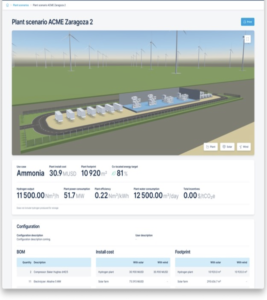
Peaxy’s new Hydrogen Digital Twin solution is an example of how the latest technology can be applied within the energy industry to drive optimization, efficiency and safety. The solution is used to optimize plant design, enhance operational efficiency, and accelerate project execution with dynamically generated 3D plant layouts, quickly and by clients without a technical background.
Measurable Results and Future Potential
The measurable impact of digital twins includes reduced failure risk, extended battery lifespan, and lower lifecycle costs. Studies show that integrating predictive models with real-time data enhances reliability and reduces unexpected outages. Cloud-based digital twins for high-voltage battery systems have also improved management and longevity through continuous monitoring.
As the technology evolves, the role of digital twins in battery analytics will continue to expand. From optimizing EV design to improving grid storage, digital twins are set to become an indispensable tool for the energy transition.
Frequently Asked Questions
What are digital twins in battery analytics?
They are virtual models of batteries or battery energy storage systems that collect and analyze sensor data. This enables real-time monitoring, predictive maintenance, and lifecycle optimization.
How do digital twins improve battery lifecycle costs?
They reduce unexpected failures, extend usable life, and support better CAPEX planning. By forecasting degradation trends, digital twins help operators avoid over- or under-investing.
Which industries benefit from digital twin analytics in batteries?
Energy storage providers, EV manufacturers, and battery OEMs all use digital twins to improve performance, ensure compliance, and reduce costs.
What role does Peaxy play in digital twins for batteries?
Peaxy delivers advanced digital twin solutions that connect design, manufacturing, and operations data. This enables customers to improve safety, compliance, and profitability.